
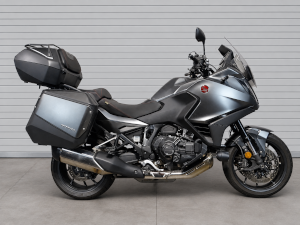
The Honda NT1100 is Honda’s versatile sport-touring motorcycle, combining long-distance comfort, agile handling and impressive performance with advanced technology. Powered by a 1,083 cc parallel-twin engine and available with Honda’s Dual Clutch Transmission (DCT), the NT1100 is designed for comfortable and relaxed touring as well as more dynamic riding. This page contains one of the most comprehensive Honda NT1100 technical specification databases available online, covering models from 2023 onwards, including official specifications, workshop data, maintenance information, dimensions, suspension settings, engine specifications, DCT information and electrical data.
Honda NT1100 – Model generations, identification & technical changes
The Honda NT1100 was introduced for the 2022 model year as a new sport-touring motorcycle based on Honda’s 1,084 cc parallel-twin platform. The model was offered with either a 6-speed manual transmission or Honda’s 6-speed Dual Clutch Transmission (DCT).
The first generation covers 2022–2024. A major technical and visual update was introduced for 2025, while the 2026 model continues this updated specification.
2022–2024 – First generation
Model years
2022 | 2023 | 2024
The 2022 NT1100 was the original version of the model. The 2023 and 2024 versions remained technically very close to the original 2022 specification.
How to recognize it
The first-generation NT1100 can be identified by:
- Original front fairing design
- Conventional twin LED headlight arrangement
- Separate front indicators
- Original fixed/adjustable windscreen design
- Original pannier design
- Original seat and bodywork
- 6.5-inch TFT touchscreen
- 17-inch front and rear wheels
- Twin exhaust outlet integrated into the lower fairing design


Engine
The first-generation NT1100 uses the 1,084 cc liquid-cooled parallel-twin engine derived from the Africa Twin.
| Specification | 2022–2024 |
|---|---|
| Displacement | 1,084 cc |
| Configuration | Parallel twin |
| Crankshaft | 270° |
| Maximum power | 75 kW / 102 PS |
| Maximum torque | 104 Nm |
| Transmission | 6-speed manual or DCT |
| Fuel tank | 20.4 L |
The engine was tuned specifically for road touring, with strong low- and mid-range performance rather than the off-road character of the Africa Twin.
DCT – 2022–2024
The optional DCT uses Honda’s established:
6-speed Dual Clutch Transmission
with two wet multi-plate clutches.
One clutch operates:
1st – 3rd – 5th
and the other:
2nd – 4th – 6th
The rider can use the DCT fully automatically or manually select gears using the handlebar switches.
Important identification point
A 2022, 2023 or 2024 NT1100 DCT does not have the six-axis IMU-based DCT control introduced for 2025.
That is one of the most important technical differences between the generations. Honda states that the DCT was redeveloped for 2025 and linked to the new six-axis IMU.
Electronics – 2022–2024
The first generation features:
- Honda Selectable Torque Control (HSTC)
- Wheelie Control
- selectable riding modes
- DCT riding modes
- cruise control
- ABS
- 6.5-inch TFT touchscreen
- Apple CarPlay
- Android Auto
- Bluetooth connectivity
- heated grips
- HISS immobiliser
The electronics are not based on the later six-axis IMU system.
2023 – Minor model-year update
Recognition
The 2023 model is visually almost identical to the 2022 model.
There are no major external design changes that reliably distinguish a 2023 from a 2022.
The differences are primarily:
- model-year colour options
- minor specification/market differences.
Technical changes
No major mechanical changes.
Engine, chassis, suspension and DCT remain essentially the same.
2022 and 2023 can therefore be regarded as the same technical generation.
2024 – Final first-generation model
Recognition
The 2024 NT1100 retains the original design.
The easiest way to identify a 2024 is therefore not by the bodywork, but by the model-year information/VIN and colour.


4
Technical changes
The 2024 model remained essentially unchanged mechanically.
The important point is:
2024 is the last year of the original NT1100 generation.
There is no 2025-style:
- six-axis IMU
- revised DCT
- new front lighting
- redesigned panniers
- revised engine.
2025 – Major technical and visual update
New generation / major facelift
Model year 2025
2025 represents the most important change in the NT1100’s history so far.
Honda substantially revised:
- engine
- DCT
- electronics
- front bodywork
- lighting
- windscreen
- seat
- panniers
- wind protection.
Honda describes the 2025 update as a major upgrade to engine performance, practicality and long-distance comfort.


5
How to recognize a 2025+ NT1100
The front end is the easiest way to identify the new generation.
1. New headlights
The 2025 model has a redesigned front fairing with new LED lighting.
2. Integrated DRL/indicators
The daytime running lights also function as the front indicators.
This is one of the easiest visual differences between:
2022–2024
and
2025+.
Honda specifically highlights the integrated DRL/indicator design.
3. New windscreen
The windscreen is now five-position adjustable and can be adjusted more easily from the riding position.
4. New panniers
The standard panniers were redesigned and increased in volume. Honda states that each pannier can now accommodate a full-face helmet.
5. Revised bodywork
The fairing has a sharper, more aggressive appearance with redesigned upper and lower wind deflectors.
2025 – Engine changes
The displacement remains:
1,084 cc
but Honda substantially revised the engine.
Changes include:
- revised intake system
- revised combustion
- revised exhaust
- increased compression ratio
- revised crankshaft/connecting-rod arrangement
- revised Throttle By Wire response.
The result is approximately 7% more low- and mid-range torque, while peak power is retained.
This is an important distinction:
The 2025 engine is not simply the 2022–2024 engine with different software.
2025 – Six-axis IMU
This is perhaps the most significant electronic change.
The 2025 NT1100 receives a:
six-axis Inertial Measurement Unit (IMU).
The IMU measures the motorcycle’s movement in real time and provides information used by the electronic control systems.
It enables improved control of:
- HSTC
- Wheelie Control
- Cornering ABS
- Rear Lift Control
- riding modes
- DCT.
Honda specifically states that the IMU is integrated with the revised DCT to improve gear selection while cornering.
2025 – Revised DCT
For the DCT version this is particularly important.
Honda redesigned the DCT control system to improve:
Low-speed operation
The DCT engages the clutch more smoothly when:
- pulling away
- manoeuvring
- riding slowly
- accelerating from low speed.
Cornering
The DCT is now linked to the six-axis IMU.
This allows the transmission to take the motorcycle’s dynamic state into account when selecting gears.
Honda describes this as more intuitive gear shifting while cornering.
In short
| 2022–2024 | 2025+ | |
|---|---|---|
| DCT | Original system | Revised system |
| Low-speed operation | Good | Improved |
| IMU integration | No | Yes |
| Cornering gear strategy | Conventional | IMU-assisted |
| Clutch control | Original calibration | Revised calibration |
For someone specifically interested in the NT1100 DCT, this is arguably the most important technical change in the entire model history.
2025 – Suspension
The standard NT1100 retains conventional Showa suspension.
However, Honda introduced a new version:
NT1100 Electronic Suspension
This version uses:
Showa EERA™ – Electronically Equipped Ride Adjustment
The system continuously adjusts damping according to riding conditions and selected riding mode. Rear spring preload can also be adjusted electronically.
Therefore, from 2025 onward there are two distinct suspension versions:
| Version | Suspension |
|---|---|
| NT1100 | Standard Showa |
| NT1100 Electronic Suspension | Showa EERA™ |
Both versions can be equipped with DCT.
2026 – Continuation of the updated generation
Model year 2026
The 2026 NT1100 continues the technical package introduced for 2025.
There is therefore no second major technical generation for 2026.
The main model-year change is the introduction of a new colour. Honda states that the 2026 model retains the major 2025 upgrades.
Technical specification
The following remain:
- revised 1,084 cc engine
- revised DCT
- six-axis IMU
- new electronics
- new front design
- integrated DRL indicators
- larger panniers
- five-position windscreen
- optional Showa EERA suspension.
Honda NT1100 – Generation overview
| Model year | Generation | Visual identification | Major technical changes |
|---|---|---|---|
| 2022 | 1st generation | Original front | New model |
| 2023 | 1st generation | Same as 2022 | Minor/model-year changes |
| 2024 | 1st generation | Same basic design | Mainly colours |
| 2025 | Major update | New headlights & integrated DRL indicators | New engine, DCT, IMU, electronics, panniers, screen, suspension option |
| 2026 | Updated generation | Same as 2025 | Mainly colour/model-year change |
Quick identification
NT1100 2022–2024
Look for:
Original headlight design + separate indicators + original fairing.
Technical characteristics:
1,084 cc / 104 Nm / original DCT / no six-axis IMU.
NT1100 2025–2026
Look for:
New twin LED headlights + DRL/indicators integrated into the headlight assembly + redesigned front fairing.
Technical characteristics:
Revised 1,084 cc engine + revised DCT + six-axis IMU + Cornering ABS + Rear Lift Control + optional Showa EERA.