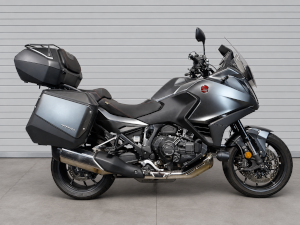
That feeling. When the bike’s packed and you’re ready to go. There’s nothing else like it.
Ready to travel? The new NTI 100 offers everything you need in one motorcycle. It’s a superb GT design — for two — and features full wind protection, adjustable screen and panniers. And it’s also loaded with a powerful, twin-cylinder engine, comprehensive electronics package and the option of our unique six-speed Dual Clutch Transmission.
The NTI 100 is also built agile for the demands of the city with light, easy handling and long travel suspension. The riding position is designed to offer the choice of engaging with sporting intent — or sitting back, relaxing, and watching the scenery roll by.
Equipment levels, as you’d expect, are high and include smartphone connectivity, cruise control and heated grips. Add premium riding technology — like Daytime Running Lights (DRC) — and there’s only one thing left to consider. Just where, and how far, do you want to go?
The Honda NT1100 was introduced as a new sport-touring motorcycle for the 2022 model year, combining the 1,084 cc parallel-twin engine derived from the CRF1100L Africa Twin with a road-focused chassis, comprehensive electronics and long-distance touring equipment.
The NT1100 was available with either a conventional 6-speed manual transmission or Honda’s 6-speed Dual Clutch Transmission (DCT). The specifications below are specifically for the 2022/2023 Honda NT1100 DCT, unless otherwise stated.
Honda’s official 2022 and 2023 specifications confirm that the 2022 and 2023 NT1100 are mechanically very similar. The 2023 model continued with the same 1,084 cc engine, 75 kW output, 104 Nm torque and DCT configuration.
Detailed information regarding the maintenance and servicing of the Honda NT1100 can be found in the Periodic maintenance overview.
Data regarding the tightening torques of all relevant parts are listed in the Tightening torques overview.
Engine
Specification
Honda NT1100 DCT 2022/2023
Engine type
Liquid-cooled 4-stroke, 8-valve parallel twin
Crankshaft
270° crankshaft
Valve drive
SOHC, Unicam
Cylinder capacity
1,084 cc / 66.1 cubic inches
Bore × stroke
92 × 81.5 mm / 3.62 × 3.21 inches
Compression ratio
10.1:1
Number of cylinders
2
Number of valves
4 per cylinder
Firing order
1–2
Cooling system
Liquid cooling
Fuel system
Honda PGM-FI electronic fuel injection
Throttle control
Throttle By Wire (TBW)
Maximum power
75 kW / 102 PS @ 7,500 rpm
Maximum torque
104 Nm @ 6,250 rpm
Starter
Electric
Fuel type
Unleaded petrol
Recommended fuel
95 RON
Fuel consumption
5.0 L/100 km (WMTC)
Emission standard
Euro 5
The 1,084 cc engine is based on the power unit used in the Honda CRF1100L Africa Twin. For the NT1100, Honda revised the intake and exhaust characteristics to provide smooth acceleration, strong mid-range performance and relaxed high-speed touring.
The 270° crankshaft produces the characteristic uneven firing interval of Honda’s parallel-twin engine.
Engine dimensions
Specification
Value
Bore
92.0 mm
Stroke
81.5 mm
Displacement
1,084 cc
Compression ratio
10.1:1
Crankshaft angle
270°
Valve arrangement
SOHC / Unicam
Valves
8
Fuel system
Specification
Value
Fuel injection
Honda PGM-FI
Throttle control
Electronic Throttle By Wire
Fuel tank capacity
20.4 litres
Recommended fuel
Unleaded petrol, 95 RON
Fuel consumption
5.0 L/100 km
Approximate theoretical range
±408 km
Actual fuel range depends on riding style, speed, load, weather and road conditions.
The system uses two wet multi-plate clutch assemblies. One clutch operates the odd-numbered gears and the other operates the even-numbered gears.
Specification
NT1100 DCT 2022/2023
Transmission
6-speed Dual Clutch Transmission
Clutch type
Dual wet multi-plate clutch
Clutch operation
Electronically/hydraulically controlled
Gear selection
Automatic or manual
Manual gear selection
Handlebar-mounted switches
Number of gears
6
Final drive
Chain
Primary reduction
1.863
Final reduction
2.500
Gear ratios
Gear
Ratio
1st
2.562
2nd
1.761
3rd
1.375
4th
1.133
5th
0.972
6th
0.882
The DCT allows the next gear to be pre-selected while the motorcycle is still using the current gear. During a shift, torque transfer is progressively moved from one clutch to the other.
This provides very fast and smooth gear changes without the need for a conventional clutch lever.
Final drive
Specification
Value
Final drive
Chain
Standard chain
RK525MRO
Number of links
122
Front sprocket
16 teeth
Rear sprocket
40 teeth
Recommended chain slack
65–70 mm
Electrical system
Specification
Value
System voltage
12 V
Battery
12 V / 11.2 Ah
Starter
Electric
Headlight
LED
Daytime running light
LED
Tail light
LED
Brake light
LED
Turn indicators
LED
12 V socket
Yes
USB connection
Yes
HISS immobiliser
Yes
Frame and chassis
Specification
Value
Frame type
Steel semi-double cradle
Subframe
Bolt-on aluminium subframe
Wheelbase
1,535 mm
Caster angle
26.5°
Trail
108 mm
Minimum ground clearance
175 mm
Minimum turning radius
Approx. 2.76 m
Suspension
Front suspension
Specification
Value
Type
Showa SFF-BP inverted telescopic fork
Fork diameter
43 mm
Travel
150 mm
Adjustment
Spring preload
Rear suspension
Specification
Value
Type
Pro-Link monoshock
Shock absorber
Showa gas-charged
Travel
150 mm
Adjustment
Hydraulic spring preload
The NT1100 was designed primarily as a road-going sport-tourer. The suspension therefore combines relatively long travel with road-oriented damping and geometry.
Brakes
Front
Specification
Value
Type
Dual hydraulic discs
Disc diameter
310 mm
Caliper
Radial-mounted four-piston
ABS
2-channel ABS
Rear
Specification
Value
Type
Single hydraulic disc
Disc diameter
256 mm
Caliper
Single-piston
ABS
2-channel ABS
Wheels and tyres
Specification
Front
Rear
Wheel type
Cast aluminium
Cast aluminium
Wheel size
17 × 3.50
17 × 5.50
Tyre size
120/70 R17
180/55 R17
Construction
Radial, tubeless
Radial, tubeless
Recommended pressure
2.50 bar
2.90 bar
Honda specified 120/70 R17 front and 180/55 R17 rear tyres for the NT1100.
Lubrication system
The NT1100 DCT uses the engine oil for lubrication of the engine and DCT system.
Specification
NT1100 DCT
Recommended oil
Honda 4-stroke motorcycle oil
Viscosity
SAE 10W-30
Specification
JASO MA
Oil capacity – after draining
4.0 L
Oil capacity – engine oil filter change
4.2 L
Oil capacity – engine + DCT filter change
4.2 L
Oil capacity – after complete disassembly
5.2 L
Cooling system capacity
Approx. 1.94 L
The DCT version has a separate clutch/DCT oil filter in addition to the engine oil filter.
Important: The 5.2-litre figure is the total capacity after complete disassembly, not the normal amount required for an oil change.
Cooling system
Specification
Value
Cooling
Liquid cooled
Coolant capacity
Approx. 1.94 litres
Thermostat
Yes
Water pump
Engine-driven
Instrumentation
The 2022/2023 NT1100 uses a 6.5-inch colour TFT touchscreen combined with a secondary LCD display.
Feature
Availability
TFT display
6.5-inch colour touchscreen
Secondary display
LCD
Speedometer
Digital
Tachometer
Digital
Fuel gauge
Yes
Coolant temperature
Yes
Trip meters
Yes
Clock
Yes
Gear indication
Yes
Riding mode indication
Yes
Apple CarPlay
Yes
Android Auto
Yes
Bluetooth connectivity
Yes
Electronic rider aids
The 2022/2023 NT1100 is equipped with an extensive electronic control system.
Riding modes
Three standard riding modes are available:
Tour
Urban
Rain
In addition, two user-configurable modes are provided:
User 1
User 2
The user modes allow the rider to configure the motorcycle’s behaviour to personal preference.
Other electronic systems
System
Availability
Honda Selectable Torque Control (HSTC)
Yes
Wheelie Control
Yes
Engine braking control
Yes
Power mode
Yes
DCT mode selection
Yes
Cruise control
Yes
ABS
Yes
Emergency Stop Signal
Yes
HISS immobiliser
Yes
Dimensions and weight
Specification
Value
Overall length
2,240 mm
Overall width
865 mm
Overall height
1,360 mm
Wheelbase
1,535 mm
Seat height
820 mm
Ground clearance
175 mm
Fuel tank
20.4 litres
Kerb weight – MT
238 kg
Kerb weight – DCT
248 kg
The quoted DCT kerb weight includes operating fluids and fuel.
Touring equipment
The NT1100 was designed specifically for long-distance road touring and was equipped as standard with a number of touring features.
Equipment
2022/2023
Cruise control
Standard
Heated grips
Standard
Side panniers
Standard
Adjustable windscreen
5-way adjustable
Upper/lower wind deflectors
Yes
Centre stand
Yes
12 V socket
Yes
USB connection
Yes
TFT touchscreen
6.5-inch
Apple CarPlay
Yes
Android Auto
Yes
Performance
Specification
Value
Maximum power
75 kW / 102 PS
Maximum torque
104 Nm
Maximum power rpm
7,500 rpm
Maximum torque rpm
6,250 rpm
Top speed
Approximately 200 km/h
Actual performance depends on rider, load, wind, road conditions and equipment.
Honda NT1100 DCT – key technical data
Category
Specification
Model
Honda NT1100 DCT
Model years
2022 / 2023
Engine
1,084 cc parallel twin
Crankshaft
270°
Valves
8
Valve drive
SOHC Unicam
Bore × stroke
92 × 81.5 mm
Compression
10.1:1
Maximum power
75 kW / 102 PS @ 7,500 rpm
Maximum torque
104 Nm @ 6,250 rpm
Transmission
6-speed DCT
Clutches
2 × wet multi-plate
Primary reduction
1.863
Final reduction
2.500
Final drive
Chain
Front wheel
17 inch
Rear wheel
17 inch
Front tyre
120/70 R17
Rear tyre
180/55 R17
Front brake
Dual 310 mm discs
Rear brake
256 mm disc
Wheelbase
1,535 mm
Seat height
820 mm
Ground clearance
175 mm
Fuel capacity
20.4 litres
Kerb weight DCT
248 kg
Engine oil – DCT service
4.2 litres
TFT display
6.5 inch
Cruise control
Yes
Heated grips
Yes
Side panniers
Standard
HISS
Yes
Riding modes
Tour / Urban / Rain / User 1 / User 2
Model year
Model introduced: 2022
Model covered by this specification: 2022/2023
The 2023 model is largely a continuation of the 2022 model. Honda’s 2023 model information confirms the same 1,084 cc engine, 75 kW maximum power, 104 Nm maximum torque, 6-speed DCT, 20.4-litre fuel tank and 248 kg DCT kerb weight.
Sources and references
Honda official 2022 NT1100 technical specifications
Honda official 2023 NT1100 technical specifications
Honda NT1100 Owner’s Manual
Honda NT1100 DCT service information
Honda CRF1100L Africa Twin technical documentation
European type-approval information
Measurements and technical data verified where possible by Heerings.net
2nd SUPPLEMENT: Technical Campaign: timing chain tensioner (Date: 10-2016). – C 600 Sport (K18, 0131/0132) – C 650 GT (K19, 0133/0134)
This BMW Motorrad Service Information Bulletin (Recall 14V-264) concerns the C 600 Sport (K18) and C 650 GT (K19) scooters. It reports that the timing-chain tensioner may wear prematurely due to a manufacturing defect, potentially causing the engine to stall. BMW replaced it with a hydraulic timing-chain tensioner starting June 2016, and this new part must be retrofitted to all affected vehicles. Dealers are legally required to complete the recall before delivery or service. The document specifies repair procedures, warranty codes, and part numbers for the replacement.
BMW says its new C650 Sport and GT maxi-scooters represent its “urban mobility” range – but that seriously undersells the ability these things showed on the open road at the launch party. Sure, they’re a great way to get passengers and luggage through city traffic, but with revised suspension and a focus on sporty handling, the C650 is more than capable of bagging sportsbike scalps in the twisties. Loz Blain went hunting at BMW’s Sydney launch party.
I’m sitting on the side of the road astride a brand new C650 Grand Touring scooter, chatting with BMW Australia’s Motorrad marketing manager Miles Davis and motoring-writer Craig Duff as we wait for the rest of the journos to catch up, when the red rag is waved.
It comes in the form of a Repsol Fireblade. I don’t know what it is about that paint job, it seems to attract MotoGP riders, morons and very little in between. This guy doesn’t look much like a MotoGP rider as he rides past us into a set of forest twisties, revving his engine and trying vainly to wheelie the thing.
Miles and I instantly respond to the smell of prey, eyes wide and thumbs on starters. We’re off before Duffy can stub his cigarette out, and a full-throttle chase is on. I wish I could tell you an epic hunt-down ensued, but the truth is we came steaming up behind that poor fool on our roaring scooters within about three corners, and passed him and his mate so fast that they decided to pull over and have a good hard think about themselves.
I’m sorry they weren’t worthy adversaries, because the new Beemer maxi-scooters are well and truly up for it, and I was hungry for scalps. There’s a perception in Australia and the United States that scooters are effeminate, wimpy machines best suited to secretaries and eccentrics, but that’s certainly not the case in Europe. And BMW has made sure these things are very capable of hard, fast riding as well as keeping things practical around town. On these kinds of tight roads where a superbike can’t stretch its legs, I reckon we could have put the fear of God into a decent rider too, and that kind of thing can correct perceptions in a hurry.
The 2016 C650 comes in two models, Sport and GT. Both are built around the same 647cc parallel twin engine as the previous model, although it’s been retuned and fitted with a new, lighter exhaust. Manufactured by Kymco in Taiwan, it punches out 60 horsepower and 63 Nm of torque, and it’s good for a top speed around 180 km/h (112 mph) – some 5 km/h faster than the previous model thanks to a revised, more responsive and more flexible CVT.
The Sport is the lighter of the two, but still not light at 249 kg (549 lbs) fully fueled. The GT comes in at a chunky 261 kg (575 lbs) – but for both bikes the mass is kept low and central. You feel the weight when you’re pushing them around, but on the move they flick deftly from side to side and the spec sheet is quickly forgotten.
Each bike comes with standard ABS (a high quality, smooth and refined system I could find no issues with) and new for 2016, there’s also standard traction control (ASC) on both C650s as well. ASC isn’t a subtle system; it flat-out chops the throttle to zero when the rear slips, making the bike feel like it’s coughing and cutting out if you try to accelerate hard on gravel. Neither system can be switched off, but intrepid owners who find either one too intrusive can possibly find a way around this in the fuse box somewhere.
In terms of practicalities, both bikes are well catered for. A fresh center-stand design makes it 30 percent lighter to lift than the old bike if you want to park it vertically. The windscreens are adjustable (manually in the Sport’s case, electronically on the GT) and there’s options for heated seats, heated grips, tire pressure monitors and things like daytime driving lights, which look pretty nifty if nothing else.
Storage is impressive (some 60 liters on the GT) as well as a few nice pop-open panels in the dash, one of which locks with the steering when you park it. I’m not sure why they’ve chosen to leave one unlocked. The Sport gets less storage in the name of saving bulk and weight, but it’s got a nifty trick up its sleeve. When you’re parked, you can unlock an extra “Flexcase” storage compartment in the back that drops down to sit on the rear wheel. It’s big enough to fit a helmet, with another in the bin at the front. You can’t start the bike without clipping it back up, but it’s still a handy feature … mind you, the GT will haul two lids and more all day long. Both bikes can be upgraded with 30-liter lockable topboxes.
On the road, the Sport and GT behave in a remarkably similar fashion despite 20-odd kilos separating them. Both take off smartly at the lights on a fully open throttle, the motor rising quickly to around 5,000 rpm where the torque kicks in and acceleration will see off most cars. The maxis are perfectly comfortable at freeway speeds, but overtaking on a twisty road above about 80 km/h takes a bit of planning. The power’s there but it takes a beat or two for the transmission to come to the party.
The 2016 models have had their suspension re-tuned to behave more like motorcycles in the corners, and it shows. I was able to ride both the Sport and the GT to about 85 percent of the pace I would on any other bike in the twisties before the suspension started feeling ever so slightly loungey and wallowy. Up until that point, it’s perfectly composed over bumps and delivers a smooth, confident and controlled ride. On 15-inch wheels, it deals with crappy road surfaces and potholes just fine.
Ground clearance was initially an issue, with hero knobs on either side of the center-stand touching down too early for my tastes, but once Craig from the BMW team cranked up the preload on the rear shock to account for my weight, it simply stopped being an issue. Pushing through to 100 percent of my normal cornering pace, they never touched down again unless I deliberately went looking for sparks.
If you’re going to lose ground to sportsbikes in the twisties, it won’t be in the corners, where these maxis are surprisingly competent. It’ll be on corner entry, where the C650’s three 270 mm brake discs (two at the front, one at the back, each fitted with twin piston calipers) just don’t have the power and feel to haul the bike up like a superbike. It’s all hands on deck and four fingers on each lever when you need to get the best out of the brakes. They’re the biggest and best brakes in the maxi class, but the handling brilliance of the rest of the bike almost demands an even bigger set of stoppers.
You’ll also lose a step on corner exits, where the transmission lags a touch before bringing full power in. To compensate, I found myself opening the throttle early; it’s actually quite good fun trying to judge the right spot in the corner to whack the throttle open.
But here’s the thing. In making these complaints I’m comparing the C650 to the best motorcycles on the road: purpose-built, corner carving fun machines that might let you squeeze your wallet under the seat if you’ve got a shoehorn and a tub of butter. Of course the C650 has niggles at ten tenths – it’s a bloody scooter, one that uses 4.5 liters to 100 km (1.2 gal to 62 miles) and gives you more than 300 km (186 mi) to a tank, one that you could take your missus around the continent on with a few dozen beers under the seat. The fact that it takes a decent spanking in the twisties is a very pleasant surprise.
BMW has designed these bikes, particularly the GT, to be visually reminiscent of the R1200RT touring bike, and I think there’s a comparison there to be made. Riders stepping down from a megatourer will find the C650 a step up in practicality for a step down in top speed that’s unlikely to bother anyone this side of an autobahn. Rider and passenger comfort are about the same – possibly even better thanks to generously sized footboards for both on the GT.
Starting at AU$14,150 for the Sport and AU$14,990 for the GT in Australia ($10,095 and $10,595 in the US), they are clearly a premium product. But not massively more expensive than the Yamaha TMAX 530 or Suzuki Burgman 650, neither of which has a German badge on it or standard traction control.
The journos on the launch ride were split roughly evenly on the question of Sport vs GT, which is a good sign. For me, I’d take the GT, because it takes more luggage and gives your passenger a plusher ride, and I didn’t feel like it was significantly wider in traffic or any slower in the fun stuff.
Either way, you’re getting a scooter that can be chugged around town clutchlessly with a coffee in your left hand, or flung into hairpins like a proper motorcycle. Hunting down Repsol Fireblades is entirely up to you, and heartily recommended.
Author: Roland Brown Photos Arnold Debus and Peter Musch Posted: 30 Oct 2015
These days BMW can claim to be an established scooter manufacturer, even if the firm’s entry to the world of small-wheeled commuters hasn’t approached the spectacular impact of its arrival in the super-sports market with the S1000RR. The German marque has sold 27,000 units of its parallel twin C-scooters since their launch three years ago: respectable by maxi-scoot standards, albeit without challenging the likes of Yamaha’s hugely popular T-Max.
That sales performance has been sufficient to encourage a revamp for 2016. The basics of 647cc liquid-cooled engine and tubular steel-framed chassis are retained, but both scooters get updated CVT transmission, traction control and new exhausts, plus revised bodywork, instruments and suspension. The C600 Sport also gets a new name, “C650 Sport” finally recognising that it shared the same engine all along. And the more touring oriented C650GT gains an optional Side View Assist system comprising warning lights, built into the mirror stalks, to warn that there’s something in the scooter’s blind spot.
Of the two it’s the Sport that is most visually different. Almost all of its bodywork is changed in an attempt to give a slightly racier look, though the essential design with its three-way manually adjustable wind-screen is retained. So too is the broad dual-seat that hinges up to reveal copious storage space, boosted by the innovative flexcase that extends towards the rear wheel, allowing a second full-face helmet to be securely stored when the scooter is parked.
At 249kg wet the Sport is no lightweight even by maxi-scooter standards. But its cleverly redesigned centre-stand was surprisingly effortless to use (as before the side-stand acts as an automatic parking brake), and the Sport was also respectably easy to manoeuvre at slow speed, its engine’s angled-forward cylinders contributing to a usefully low centre of gravity.
Flicking through traffic at the start of the launch ride in Valencia was effortless, the BMW feeling very well balanced, and its revised injection and CVT transmission systems working sufficiently sweetly to keep the scooter well balanced. Ride quality in town was good too. The upside-down forks and monoshock have ten per cent lighter springs, which along with revised damping allowed the Sport to float over minor bumps while keeping a well controlled feel.
With an unchanged maximum output of 60bhp at 7500rpm the C-scooters are powerful even by maxi-scooter standards, and BMW say the revised CVT system (whose mods include lighter springs) gives slightly improved acceleration plus a few extra mph on top speed. The Sport certainly left most Valencian traffic in its wake with minimal effort, and when we reached a main road cruised at an indicated 80mph feeling effortlessly smooth and unstressed, rumbling up to an indicated 100mph on one short straight before I had to slow with about 10mph more to come.
High-speed stability was flawless and handling very adequate, combining reasonably light steering with good suspension control despite the softer springs. On twisty roads north of Valencia the Sport could be flicked around at a decent pace. Its Pirelli Diablo Scooter tyres gave plenty of grip, now backed up by BMW’s ATC traction control system. And the triple-disc brake system, with twin-pot front calipers, meant respectably good stopping power too, in conjunction with unchanged Bosch ABS.
On straighter roads I was less impressed to find that, unsurprisingly, wind protection was no better than I recall from the original C600. There’s nothing wrong with the screen’s simple but effective three-way adjustment system, which requires two knobs to be loosened, and can be done in a couple of minutes. But as before even the highest setting was too low for me and other taller-than-average riders, generating a loud wind roar that made main-road cruising unnecessarily tiring. Shorter riders would doubtless be more impressed but it’s a shame the screen hasn’t been improved.
Comfort in other respects was reasonable, although the generously long and broad dual-seat eventually generated a bit of lower back pain, possibly due to my tendency to crouch down to escape the wind. At least there are generous footboards for the pilot, and if a pillion gets only footpegs the rear seat does incorporate generously large and sturdy grab-handles.
And there are plenty of other practical touches, including the new instrument panel, which combines an analogue speedo with a digital panel (showing fuel consumption etc) that can be toggled from the handlebar. The unchanged 15.5-litre tank, shared by both models, would typically be good for over 160 miles at the launch average of 55mpg. If the C650 Sport can’t quite match the light weight and cornering poise of Yamaha’s T-Max, its ultra-popular target as a sporty maxi-scooter, it’s more powerful and arguably more practical as well as more expensive.
But if you’re looking for comfort and practicality from a maxi-scooter it’s the more luxurious C650GT that’s the better of BMW’s duo. The GT hasn’t had such a big visual makeover as the Sport, merely getting a reshaped rear end including the tail light. But it’s a smart looking machine and, like the other model, adds to that impression with new handlebar trim and instrument console.
The GT is 12kg heavier at 261kg wet but still managed to feel reasonably manoeuvrable, even in traffic where its broad and slightly taller (at 805mm) seat had shorter riders straining slightly to get both feet on the ground. It’s a brilliantly comfortable place to sit, though, helped in the rider’s case by the substantial lumbar pad that gave useful support. The upmarket Highline version of both models also gets a heated seat with individual controls for rider and pillion, who in the GT’s case is treated to footboards as well as grab-handles.
Wind protection is also notably better than the Sport’s, thanks to a screen that is taller and wider as well as electronically adjustable. As before the range of adjustment isn’t that great, and being very tall I’d still have liked to raise it slightly more. But protection was generally good, and the ride was pretty quiet at the steady 80mph-plus cruise that the GT was effortlessly capable of holding.
The GT is a practical machine, too, with room under its seat for a full-face and an open-face helmet, though strangely BMW still haven’t given the GT the benefit of the Sport’s clever space-adding flexcase. It does however get larger and very clear mirrors, and also comes with the innovative option of Side View Assist: basically a blind-spot warning that alerts the rider by flashing small lights on the mirror stalks when a vehicle is in the crucial hard-to-spot area.
This isn’t something I’ve ever thought I needed on a bike or scooter – it’s easy enough to turn your head, after all – so I was surprised to find the SVA system useful, especially in Valencia’s multi-lane traffic when the occasional flashing light signalled a car or scooter that I wasn’t aware of. The system would be even more valuable on a bike with less effective mirrors than the GT.
As it is I’d be tempted to pay the extra £360 for SVA, even though the Highline version of the GT is already far from cheap, at £10,390 (the basic model is £9900). The Sport costs slightly less, at £9600 for the base model and £10,375 for the Highline, which incorporates daytime riding lights, tyre pressure monitor and LED indicators as well as the heated grips and seat. Despite that I’d rate the C650GT as the better buy, at least for anyone contemplating reasonable distances. Its price is high but buys a scooter that would make a good job of commuting, touring or pretty much anything in between.
TECHNICAL SPECS
Price
Sport £10,375 Highline, £9600 basic [GT £10,390 Highline, £9900 basic]
Power
60bhp, 44ft.lbs
Wet weight
249kg wet [GT 261kg]
Seat height
800mm [GT 805mm]
Colours
Matt orange (£85 extra), white, black. [GT matt bronze (£85 extra), white, black]
VERDICT
Revamped pair of upmarket maxi-scooters with pace, comfort and features to match their premium prices.
Effortless high-speed cruising, sound handling and practicality make the tweaked C-scooters fine all-rounders, especially the more luxurious GT with its superior screen and seat
The 2016 BMW C650 GT (short for “Gran Turismo”) is not your typical scooter. There’s something magical about it that makes this high capacity maxi-scooter above par for conventional standards. Right off the bat, the C650GT grabbed my attention as it doesn’t look like any scooter I’ve ever seen. With its sporty styling and modern design, it’s definitely raising the bar for the scooter market. The 2016 model has several new design changes that were derived from the automotive side of BMW – this adds to the overall appeal.
I really enjoyed riding this scooter – it’s extremely comfortable, well-balanced, and at 650cc it has plenty of punch that’s sure enough to leave most cars behind. With a sticker price of $12,285 it may catch most by surprise as it seems expensive for a scooter. When factoring in what you actually get for that, such as heated grips, heated seats, tire pressure monitoring, a full warranty and roadside assistance, one can easily start to justify the price tag that comes with this luxury two-wheeler.
The C650 GT has a ton of storage both under the seats, as well as built into the front fairing. Two things I noted about the storage is that only the front left storage compartment is lockable and that is achieved by locking the steering to the left. This renders the right side unlockable, which can be a bit annoying. The trunk has a built-in LED, which I found to be extremely helpful when getting my belongings out in the dark. One last thing to note about the storage is that the C650 GT features the largest storage in its class, with the ability to store two full-face helmets.
A few of the additional standard features included on the C650GT are ABS, automatic stability control, electronically adjustable windshield, as well as an automatic parking brake that engages when the side stand is lowered. With a plethora of options available from BMW, such as a smart phone cradle, storage rack, storage pod for the rear or storage bag for the center between your legs, navigation and communication as well as many more, there’s sure to be a combination of options that are sure to suit your specific needs.
The CVT transmission is extremely smooth, making “shifts” seamless – this adds to the overall comfort. With a wet weight of 575 pounds, the C650GT isn’t light nor is it small by any means, but none of that seems to matter. Thanks to the low center of gravity and CVT gearbox, it’s effortless to maintain balance at low speeds. Even with a passenger, you can practically stand still on the spot. Braking is sufficient with its twin rotor 270mm dual piston front calipers paired with factory ABS.
Highway speeds were effortless to achieve and maneuvering through traffic was just as effortless. One thing I noted during my time with the C650GT was how smooth the transition from braking to acceleration through corners and bends was. There is no jerky transition that catches you off-guard whether you feather the throttle or roll into it hard so you can corner with confidence.
Comfort was not overlooked when BMW designed the C650GT. The rider has several options when it comes to foot placement, whether legs are stretched out or kept back for a more aggressive riding position. The rider’s backrest is very comfortable, it keeps you in your spot when you’re under hard acceleration, and the “GT” stitching is a tasteful touch. A massive passenger seat renders the passenger just as coddled, its hand-holds are very sturdy and ride height is in a well-positioned spot giving a nice field of view over the rider, while maintaining adequate wind shielding. The only problem with passenger comfort was the lack of a passenger back rest, which is a must-have option in my head.
One funny quirk that kept catching me off-guard was the starting procedure. The bike will not start if the kickstand is down or the brake lever isn’t pressed. It took a minute of confusion on more than one occasion before figuring out why the bike wouldn’t turn over. The engine is a little louder than I would have expected, and the exhaust is newly designed for 2016 with a nice note. The heated grips and seats seemed like a bit more of a novelty than anything to me, as I tend to only ride during warm weather, but riding after dark, and going through low valleys where the temperature drops, they were a much-appreciated feature that left both my passenger and I comfortable.
Comfort and quality come together to make the 2016 BMW C650GT a very well rounded maxi-scooter. Perhaps scooters won’t be as popular in North America as in Europe, but the C650GT is definitely paving the way when it comes to a comfortable mode of transportation. If you’re in the market for a large capacity scooter, or even a touring motorcycle, I’d give the C650GT a look – it may just win you over.
Maintenance Schedule for BMW C 650 GT and BMW C 650 Sport.
Running-in Check (After 1.000 km)
– Setting service-due date and countdown distance – Performing vehicle test with BMW Motorrad diagnostic system – Replacing front oil strainer by oil intake pipe – Changing engine oil with filter – Checking chain sag – Checking front/rear brake-fluid level – Lubricating side stand – Checking basic setting and braking effect of parking brake – Checking play of throttle cable – Checking coolant level – Checking tyre pressures and tread depth – Checking steering-head bearing – Checking lights and signalling equipment – Function test, engine start suppression – Final inspection and check of roadworthiness – Performing vehicle test with BMW Motorrad diagnostic system – Confirming BMW Service in on-board documentation – Setting service-due date and service countdown distance: Next service on 10.000km
After 10.000 km
– Checking battery charge state – Performing vehicle test with BMW Motorrad diagnostic system – Oil change, engine, with filter (11 00 611) – Visually inspecting brake pipes, brake hoses and connections – Change brake fluid in entire system (34 00 504) – Checking front brake pads and brake discs for wear – Checking rear brake pads and brake disc for wear – Lubricating side stand – Checking basic setting and braking effect of parking brake – Checking steering-head bearing – Checking coolant level – Checking play of throttle cable – Checking chain sag – Checking tyre pressures and tread depth – Checking lights and signalling equipment – Function test, engine start suppression – Final inspection and check of roadworthiness – Performing vehicle test with BMW Motorrad diagnostic system – Setting service-due date and service countdown distance: Next service on 20.000km
After 20.000 km
– Checking battery charge state – Performing vehicle test with BMW Motorrad diagnostic system – Oil change, engine, with filter (11 00 611) – Replace air filter cartridge for maintenance (13 72 505) – Visually inspecting brake pipes, brake hoses and connections – Change brake fluid in entire system (34 00 504) – Checking front brake pads and brake discs for wear – Checking rear brake pads and brake disc for wear – Lubricating side stand – Checking basic setting and braking effect of parking brake – Checking steering-head bearing – Checking coolant level – Checking play of throttle cable – Replacing CVT belt with rollers for maintenance (24 82 501) – Checking chain sag – Replacing chainset for maintenance (33 81 501) – Checking tyre pressures and tread depth – Checking lights and signalling equipment – Function test, engine start suppression – Final inspection and check of roadworthiness – Performing vehicle test with BMW Motorrad diagnostic system – Setting service-due date and service countdown distance: Next service on 30.000km
After 30.000 km
– Checking battery charge state – Performing vehicle test with BMW Motorrad diagnostic system – Oil change, engine, with filter (11 00 611) – Replace air filter cartridge for maintenance (13 72 505) – Visually inspecting brake pipes, brake hoses and connections – Change brake fluid in entire system (34 00 504) – Checking front brake pads and brake discs for wear – Checking rear brake pads and brake disc for wear – Lubricating side stand – Checking basic setting and braking effect of parking brake – Checking steering-head bearing – Checking coolant level – Checking play of throttle cable – Checking chain sag – Replacing chainset for maintenance (33 81 501) – Checking tyre pressures and tread depth – Checking lights and signalling equipment – Function test, engine start suppression – Final inspection and check of roadworthiness – Performing vehicle test with BMW Motorrad diagnostic system – Setting service-due date and service countdown distance: Next service on 40.000km
After 40.000 km
– Checking battery charge state – Performing vehicle test with BMW Motorrad diagnostic system – Oil change, engine, with filter (11 00 611) – Replace air filter cartridge for maintenance (13 72 505) – Gearbox-oil change (23 00 510) – Replace all spark plugs as part of maintenance (12 12 509) – Checking valve clearance , Visually inspecting brake pipes, brake hoses and – connections (11 34 502) – Change brake fluid in entire system (34 00 504) – Checking front brake pads and brake discs for wear – Checking rear brake pads and brake disc for wear – Lubricating side stand – Checking basic setting and braking effect of parking brake – Checking steering-head bearing – Checking coolant level – Checking play of throttle cable – Replacing CVT belt with rollers for maintenance (24 82 501) – Checking chain sag – Replacing chainset for maintenance (33 81 501) – Checking tyre pressures and tread depth – Checking lights and signalling equipment – Function test, engine start suppression – Final inspection and check of roadworthiness – Performing vehicle test with BMW Motorrad diagnostic system – Setting service-due date and service countdown distance