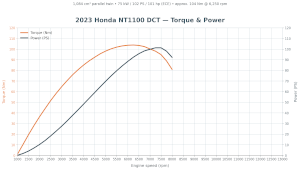
The torque and power curves give a good impression of the character of the Honda NT1100 DCT’s 1,084 cc parallel-twin engine. The graph shows how torque builds strongly from low engine speeds and remains substantial across a broad part of the rev range, providing the relaxed and effortless power delivery that suits the NT1100’s touring character.
The accompanying data table can also be used to recreate the graph in Microsoft Excel or Google Sheets. The values have been digitally reconstructed from the original graph and should therefore be regarded as approximate reference data.
How to read the graph
Torque describes the engine’s ability to produce rotational force, while power describes how quickly that torque can be converted into work. The NT1100 develops its maximum torque at 6,250 rpm and its maximum power at 7,500 rpm. Because strong torque is available across a broad part of the rev range, the engine does not need to be operated at high rpm to deliver useful acceleration.
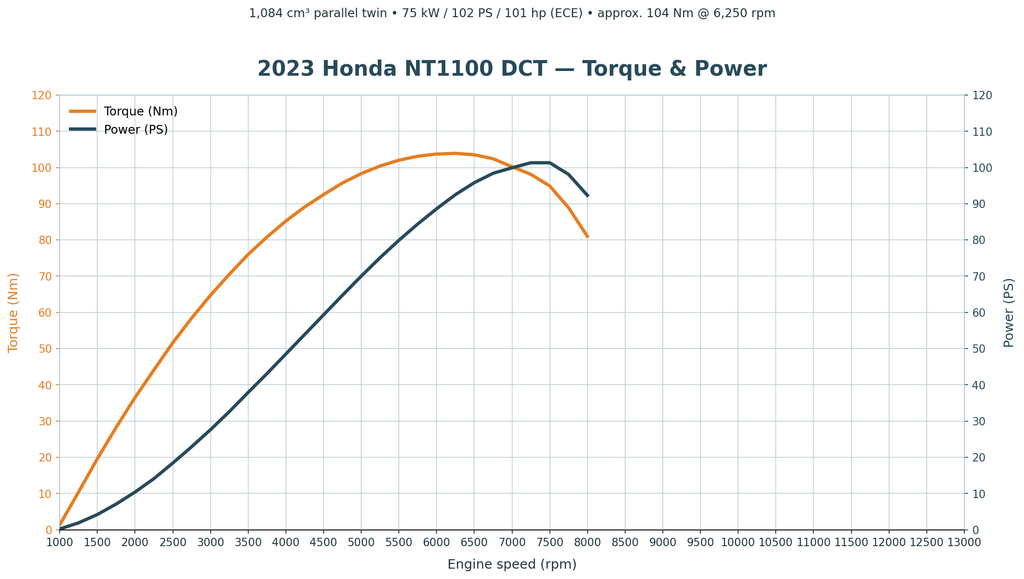
The table contains values per 500 rpm.
| RPM | Torque (Nm) | Power (PS) |
|---|---|---|
| 1,000 | 1.3 | 0.2 |
| 1,500 | 19.6 | 4.2 |
| 2,000 | 36.5 | 10.4 |
| 2,500 | 51.6 | 18.4 |
| 3,000 | 64.7 | 27.6 |
| 3,500 | 76.0 | 37.9 |
| 4,000 | 85.2 | 48.5 |
| 4,500 | 92.5 | 59.3 |
| 5,000 | 98.3 | 70.0 |
| 5,500 | 102.0 | 79.9 |
| 6,000 | 103.7 | 88.6 |
| 6,250 | 103.9 | 92.5 |
| 6,500 | 103.5 | 95.8 |
| 6,750 | 102.4 | 98.4 |
| 7,000 | 100.2 | 99.8 |
| 7,250 | 98.1 | 101.3 |
| 7,500 | 94.9 | 101.4 |
| 7,750 | 88.9 | 98.1 |
| 8,000 | 81.0 | 92.3 |
Engine RPM vs. Road Speed – All 6 DCT Gears
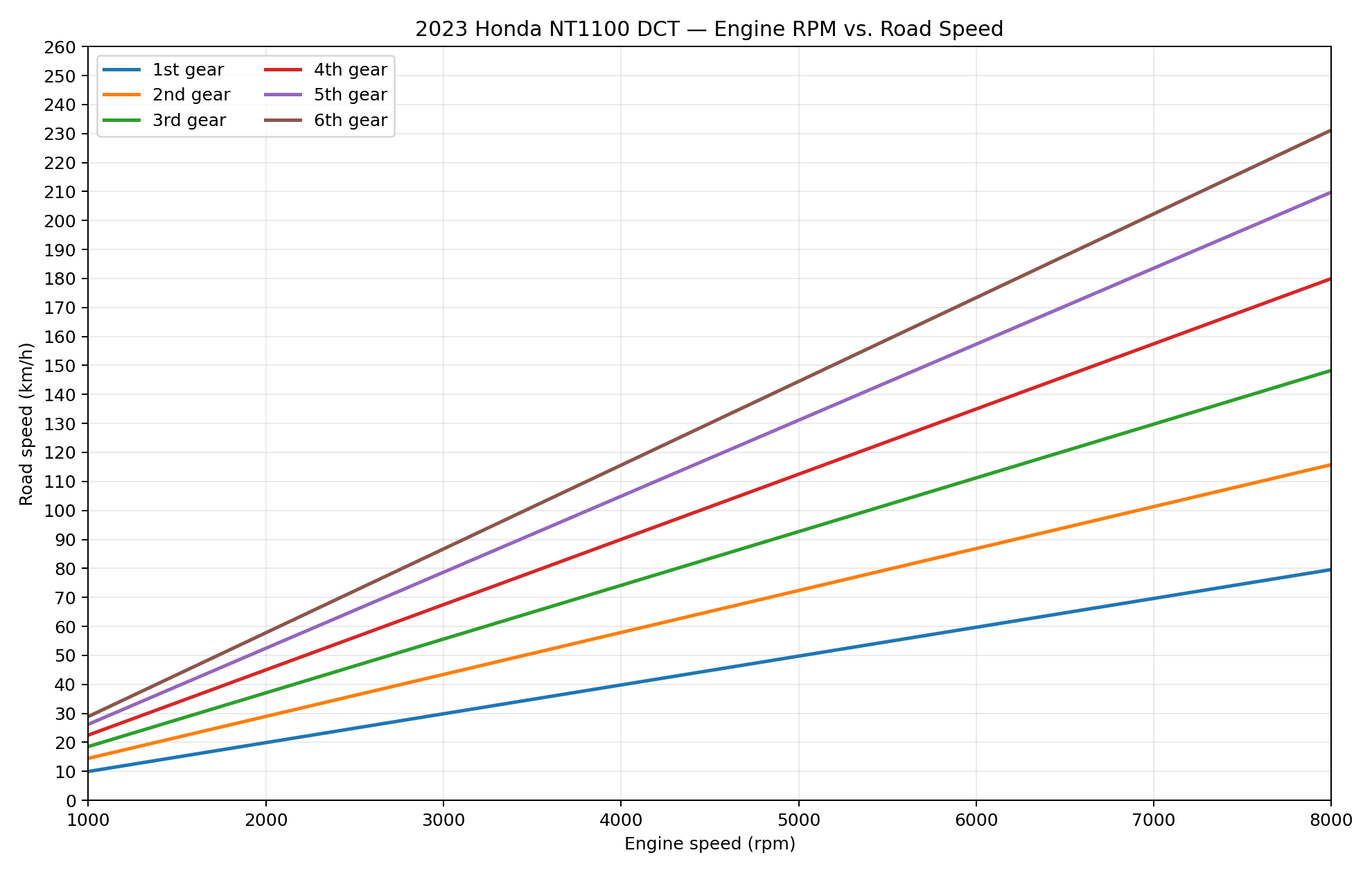
The following graph shows the relationship between engine speed (RPM) and road speed for all six gears of the Honda NT1100 DCT. It provides a useful insight into how the Dual Clutch Transmission (DCT) translates engine speed into actual road speed.
How to read the graph
The horizontal axis represents engine speed in revolutions per minute (RPM), while the vertical axis shows the corresponding theoretical road speed in km/h.
Each line represents one of the six DCT gears. Because the transmission ratios become progressively taller, the motorcycle covers more distance at the same engine speed as it shifts from first to sixth gear.
For example, at 4,000 rpm, the theoretical speeds are approximately:
| Gear | Road speed |
|---|---|
| 1st | 44 km/h |
| 2nd | 64 km/h |
| 3rd | 82 km/h |
| 4th | 100 km/h |
| 5th | 116 km/h |
| 6th | 128 km/h |
This also illustrates why sixth gear is particularly well suited to relaxed touring. At higher road speeds, the engine can run at relatively low RPM, helping to keep the ride smooth and effortless.
Transmission data
The calculations are based on the 2023 Honda NT1100 DCT transmission ratios:
| Specification | Value |
|---|---|
| Primary reduction | 1.863 |
| 1st gear | 2.562 |
| 2nd gear | 1.761 |
| 3rd gear | 1.375 |
| 4th gear | 1.133 |
| 5th gear | 0.972 |
| 6th gear | 0.882 |
| Final reduction | 2.500 |
| Rear tyre | 180/55 ZR17 |
The calculation uses the theoretical circumference of a 180/55 ZR17 rear tyre (approximately 1.979 m). Actual road speed can differ slightly because the effective rolling circumference changes with tyre wear, tyre pressure, rider/passenger load and other factors.
A useful combination
Together with the Torque & Power graph, this graph gives a much more complete picture of the NT1100’s engine and DCT characteristics:
Torque & Power shows what the engine produces, while RPM vs. Road Speed shows how the DCT uses it.