
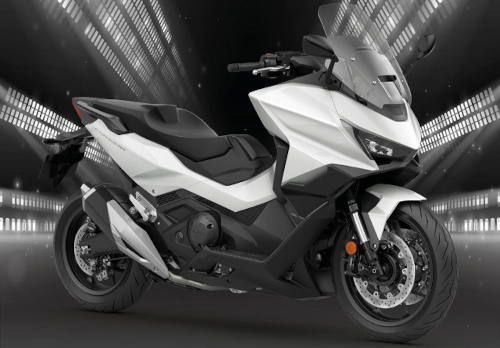
Overview of Honda Forza Scooter Models
The Honda Forza name was first introduced in Japan in 2000 on a premium 250cc maxi-scooter. Over the years, the Forza evolved into Honda’s flagship scooter range, covering everything from lightweight commuter scooters to large-capacity touring models. Today, the Forza family consists primarily of the 125, 350, and 750 models.
Honda Forza Timeline
| Year | Model | Key Features and Changes |
|---|---|---|
| 2000 | Forza 250 (MF06) | First Forza model. Premium 250cc scooter for the Japanese market, featuring modern styling and practical touring capabilities. |
| 2004 | Forza 250 (MF08) | Major redesign with Honda’s electronically controlled CVT transmission (Honda S-Matic), improved comfort, and more luxury features. |
| 2008 | Forza 250 (MF10) | New bodywork, upgraded electronics, optional ABS, improved transmission, and available audio system. |
| 2013 | Forza 300 | First modern European Forza. Larger engine, increased storage capacity, and a stronger focus on commuting and touring. |
| 2015 | Forza 125 | Developed specifically for the European A1 licensing market. Quickly became one of Europe’s most successful premium 125cc scooters. |
| 2018 | New-generation Forza 125 & Forza 300 | Completely redesigned. Lighter chassis, sharper styling, electric windscreen, Smart Key system, LED lighting, and Honda Selectable Torque Control (traction control). |
| 2021 | Forza 350 | Replaced the Forza 300. Engine enlarged from 279cc to 330cc, providing more power, better acceleration, and Euro 5 compliance. |
| 2021 | Forza 750 | New flagship model powered by a 745cc parallel-twin engine with Dual Clutch Transmission (DCT). Directly derived from the Honda Integra platform. |
| 2025 | Forza 750 (Facelift) | Revised front styling, improved DCT software, larger electrically adjustable windscreen, Euro 5+ compliance, and standard cruise control. |
Was the Honda Integra the Predecessor of the Forza 750?
Yes, very much so.
The Honda NC700D Integra, introduced in 2012, was a unique crossover between a motorcycle and a scooter. It shared its platform with the NC700S and NC700X motorcycles and featured Honda’s innovative Dual Clutch Transmission (DCT).
In 2014, the model evolved into the NC750D Integra, receiving a larger 745cc engine and various refinements.
When Honda launched the Forza 750 in 2021, it was widely regarded as the spiritual and technical successor to the Integra. Many motorcycle journalists described it as “Integra 2.0” because it retained the same basic engine architecture, frame concept, and DCT transmission while adding significantly more comfort, technology, and premium styling.
Evolution of Honda’s Large-Capacity Scooter Line
2012  NC700D Integra
          ↓
2014  NC750D Integra
          ↓
2021  Forza 750
          ↓
2025  Forza 750 Facelift
Key Differences Between the Integra 750 and the Forza 750
| Feature | NC750D Integra | Forza 750 |
|---|---|---|
| Introduction | 2014 | 2021 |
| Design Philosophy | Motorcycle-scooter hybrid | Premium GT maxi-scooter |
| Dashboard | LCD display | Full-color TFT display |
| Electronics | Basic DCT controls | Ride-by-wire, riding modes, cruise control |
| Storage Space | Limited under-seat storage | Larger under-seat compartment |
| Lighting | Early LED technology | Advanced full-LED lighting |
| Touring Comfort | Good | Significantly improved |
| Engine | 745cc parallel twin | Updated 745cc parallel twin |
| Power Output | Approx. 55 hp | Approx. 58 hp |
| Connectivity | None | Smartphone connectivity available |
Major Generational Improvements
Forza 250 (2000 → 2004)
- Introduction of electronic CVT control.
- More premium equipment.
- Improved rider comfort.
Forza 250 (2004 → 2008)
- New body design.
- Optional ABS.
- Improved transmission management.
- Enhanced electronics.
Forza 300 (2013 → 2018)
- Weight reduction.
- Sharper, sportier styling.
- Electric windscreen.
- Smart Key system.
- Traction control.
Forza 300 (2018 → 2021 Forza 350)
- Increased displacement (279cc → 330cc).
- Higher top speed.
- Stronger acceleration.
- Euro 5 compliance.
Integra 750 (2014 → 2021 Forza 750)
- More luxurious bodywork.
- Significantly larger storage compartment.
- Ride-by-wire throttle.
- Multiple riding modes.
- Improved DCT operation.
- TFT instrumentation.
- Premium GT touring focus.
Forza 750 (2021 → 2025)
- Updated front-end styling.
- Enhanced DCT software calibration.
- Larger electrically adjustable windscreen.
- Standard cruise control.
- Euro 5+ emissions compliance.
An Interesting Historical Note
Although the Forza 750 is the flagship model today, its roots actually lie in two different Honda lineages:
- The Forza family (premium scooters beginning in 2000).
- The Integra family (DCT-powered scooter/motorcycle hybrids beginning in 2012).
The Forza 750 effectively merged these two concepts into a single machine: the practicality and luxury of the Forza range combined with the powerful twin-cylinder engine and DCT technology developed for the Integra.
Summary
- 2000: First Honda Forza 250 introduced in Japan.
- 2013: Forza 300 launched for Europe.
- 2015: Forza 125 introduced.
- 2021: Forza 350 replaces the 300.
- 2021: Forza 750 replaces the Integra as Honda’s premium large-capacity scooter.
- 2025: Latest Forza 750 facelift introduced.