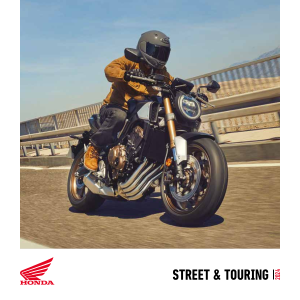
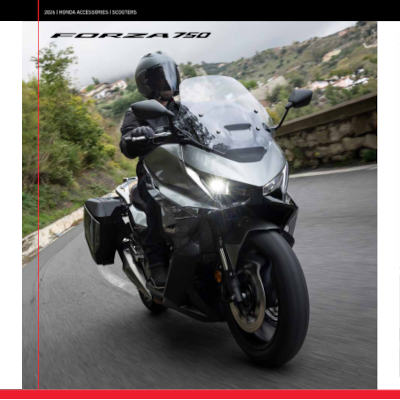
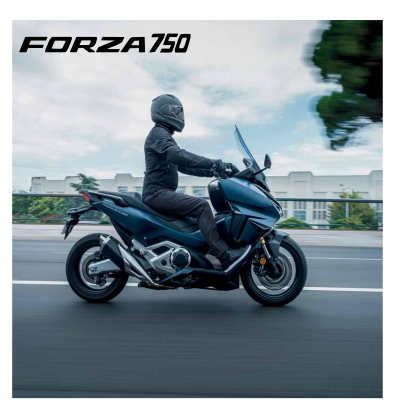
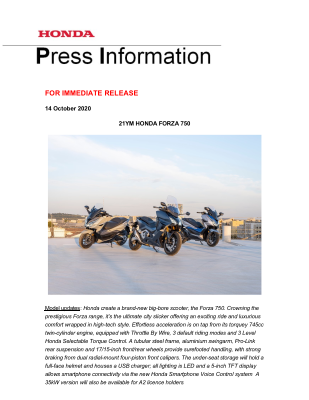
Hit the road with confidence, style and the freedom to go wherever you please. Discover the city and everything it has to offer. Or set out to explore the wider world and embark on a long, unforgettable journey through villages, countries and continents.
Ga de straat op vol zelfvertrouwen, in stijl en met een veelzijdige vrijheid. Ontdek de stad en al wat ze te bieden heeft. Of ga de wijde wereld verkennen en vertrek op een lange, onvergetelijke reis doorheen dorpen, landen en continenten.
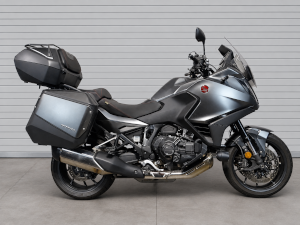
Taking the heart of the CRF1100L Africa Twin as a starting point, the NT1100 builds on the platform to offer comfortable, agile, enjoyable performance. A low seat height and sharp steering geometry combine with high specification suspension to create a sporting package. 5way height and angle adjustable screen and upper/lower wind deflectors ensure highspeed aero efficiency and outstanding weather protection; cruise control is standard, as are slim panniers and heated grips.
Rider aids include 3 default riding modes, 2 user custom options, Honda Selectable Torque Control (HSTC) and Wheelie Control. Radialmount fourpiston front calipers provide the braking power, 120/7017 and 180/5517 front and rear tyres the grip. A 6.5inch TFT touch screen rounds out a premium specification and features Apple CarPlay® and Android Auto® connectivity.
Honda have long held a reputation for making dynamic, practical and versatile tourers. Icons like the Pan European and Deauville generated a loyal customer following by offering genuine country-crossing appeal in an exciting package.
The 2022 NT1100 continues this tradition. With its blend of sporty performance, allday comfort and rich specification list, heralding a New Touring Era, the NT1100 is a machine that can just as easily take you across the country as take you to work.
That feeling. When the bike’s packed and you’re ready to go. There’s nothing else like it.
Ready to travel? The new NTI 100 offers everything you need in one motorcycle. It’s a superb GT design — for two — and features full wind protection, adjustable screen and panniers. And it’s also loaded with a powerful, twin-cylinder engine, comprehensive electronics package and the option of our unique six-speed Dual Clutch Transmission.
The NTI 100 is also built agile for the demands of the city with light, easy handling and long travel suspension. The riding position is designed to offer the choice of engaging with sporting intent — or sitting back, relaxing, and watching the scenery roll by.
Equipment levels, as you’d expect, are high and include smartphone connectivity, cruise control and heated grips. Add premium riding technology — like Daytime Running Lights (DRC) — and there’s only one thing left to consider. Just where, and how far, do you want to go?
The Honda NT1100 was introduced as a new sport-touring motorcycle for the 2022 model year, combining the 1,084 cc parallel-twin engine derived from the CRF1100L Africa Twin with a road-focused chassis, comprehensive electronics and long-distance touring equipment.
The NT1100 was available with either a conventional 6-speed manual transmission or Honda’s 6-speed Dual Clutch Transmission (DCT). The specifications below are specifically for the 2022/2023 Honda NT1100 DCT, unless otherwise stated.
Honda’s official 2022 and 2023 specifications confirm that the 2022 and 2023 NT1100 are mechanically very similar. The 2023 model continued with the same 1,084 cc engine, 75 kW output, 104 Nm torque and DCT configuration.
Detailed information regarding the maintenance and servicing of the Honda NT1100 can be found in the Periodic maintenance overview.
Data regarding the tightening torques of all relevant parts are listed in the Tightening torques overview.
Engine
Specification
Honda NT1100 DCT 2022/2023
Engine type
Liquid-cooled 4-stroke, 8-valve parallel twin
Crankshaft
270° crankshaft
Valve drive
SOHC, Unicam
Cylinder capacity
1,084 cc / 66.1 cubic inches
Bore × stroke
92 × 81.5 mm / 3.62 × 3.21 inches
Compression ratio
10.1:1
Number of cylinders
2
Number of valves
4 per cylinder
Firing order
1–2
Cooling system
Liquid cooling
Fuel system
Honda PGM-FI electronic fuel injection
Throttle control
Throttle By Wire (TBW)
Maximum power
75 kW / 102 PS @ 7,500 rpm
Maximum torque
104 Nm @ 6,250 rpm
Starter
Electric
Fuel type
Unleaded petrol
Recommended fuel
95 RON
Fuel consumption
5.0 L/100 km (WMTC)
Emission standard
Euro 5
The 1,084 cc engine is based on the power unit used in the Honda CRF1100L Africa Twin. For the NT1100, Honda revised the intake and exhaust characteristics to provide smooth acceleration, strong mid-range performance and relaxed high-speed touring.
The 270° crankshaft produces the characteristic uneven firing interval of Honda’s parallel-twin engine.
Engine dimensions
Specification
Value
Bore
92.0 mm
Stroke
81.5 mm
Displacement
1,084 cc
Compression ratio
10.1:1
Crankshaft angle
270°
Valve arrangement
SOHC / Unicam
Valves
8
Fuel system
Specification
Value
Fuel injection
Honda PGM-FI
Throttle control
Electronic Throttle By Wire
Fuel tank capacity
20.4 litres
Recommended fuel
Unleaded petrol, 95 RON
Fuel consumption
5.0 L/100 km
Approximate theoretical range
±408 km
Actual fuel range depends on riding style, speed, load, weather and road conditions.
The system uses two wet multi-plate clutch assemblies. One clutch operates the odd-numbered gears and the other operates the even-numbered gears.
Specification
NT1100 DCT 2022/2023
Transmission
6-speed Dual Clutch Transmission
Clutch type
Dual wet multi-plate clutch
Clutch operation
Electronically/hydraulically controlled
Gear selection
Automatic or manual
Manual gear selection
Handlebar-mounted switches
Number of gears
6
Final drive
Chain
Primary reduction
1.863
Final reduction
2.500
Gear ratios
Gear
Ratio
1st
2.562
2nd
1.761
3rd
1.375
4th
1.133
5th
0.972
6th
0.882
The DCT allows the next gear to be pre-selected while the motorcycle is still using the current gear. During a shift, torque transfer is progressively moved from one clutch to the other.
This provides very fast and smooth gear changes without the need for a conventional clutch lever.
Final drive
Specification
Value
Final drive
Chain
Standard chain
RK525MRO
Number of links
122
Front sprocket
16 teeth
Rear sprocket
40 teeth
Recommended chain slack
65–70 mm
Electrical system
Specification
Value
System voltage
12 V
Battery
12 V / 11.2 Ah
Starter
Electric
Headlight
LED
Daytime running light
LED
Tail light
LED
Brake light
LED
Turn indicators
LED
12 V socket
Yes
USB connection
Yes
HISS immobiliser
Yes
Frame and chassis
Specification
Value
Frame type
Steel semi-double cradle
Subframe
Bolt-on aluminium subframe
Wheelbase
1,535 mm
Caster angle
26.5°
Trail
108 mm
Minimum ground clearance
175 mm
Minimum turning radius
Approx. 2.76 m
Suspension
Front suspension
Specification
Value
Type
Showa SFF-BP inverted telescopic fork
Fork diameter
43 mm
Travel
150 mm
Adjustment
Spring preload
Rear suspension
Specification
Value
Type
Pro-Link monoshock
Shock absorber
Showa gas-charged
Travel
150 mm
Adjustment
Hydraulic spring preload
The NT1100 was designed primarily as a road-going sport-tourer. The suspension therefore combines relatively long travel with road-oriented damping and geometry.
Brakes
Front
Specification
Value
Type
Dual hydraulic discs
Disc diameter
310 mm
Caliper
Radial-mounted four-piston
ABS
2-channel ABS
Rear
Specification
Value
Type
Single hydraulic disc
Disc diameter
256 mm
Caliper
Single-piston
ABS
2-channel ABS
Wheels and tyres
Specification
Front
Rear
Wheel type
Cast aluminium
Cast aluminium
Wheel size
17 × 3.50
17 × 5.50
Tyre size
120/70 R17
180/55 R17
Construction
Radial, tubeless
Radial, tubeless
Recommended pressure
2.50 bar
2.90 bar
Honda specified 120/70 R17 front and 180/55 R17 rear tyres for the NT1100.
Lubrication system
The NT1100 DCT uses the engine oil for lubrication of the engine and DCT system.
Specification
NT1100 DCT
Recommended oil
Honda 4-stroke motorcycle oil
Viscosity
SAE 10W-30
Specification
JASO MA
Oil capacity – after draining
4.0 L
Oil capacity – engine oil filter change
4.2 L
Oil capacity – engine + DCT filter change
4.2 L
Oil capacity – after complete disassembly
5.2 L
Cooling system capacity
Approx. 1.94 L
The DCT version has a separate clutch/DCT oil filter in addition to the engine oil filter.
Important: The 5.2-litre figure is the total capacity after complete disassembly, not the normal amount required for an oil change.
Cooling system
Specification
Value
Cooling
Liquid cooled
Coolant capacity
Approx. 1.94 litres
Thermostat
Yes
Water pump
Engine-driven
Instrumentation
The 2022/2023 NT1100 uses a 6.5-inch colour TFT touchscreen combined with a secondary LCD display.
Feature
Availability
TFT display
6.5-inch colour touchscreen
Secondary display
LCD
Speedometer
Digital
Tachometer
Digital
Fuel gauge
Yes
Coolant temperature
Yes
Trip meters
Yes
Clock
Yes
Gear indication
Yes
Riding mode indication
Yes
Apple CarPlay
Yes
Android Auto
Yes
Bluetooth connectivity
Yes
Electronic rider aids
The 2022/2023 NT1100 is equipped with an extensive electronic control system.
Riding modes
Three standard riding modes are available:
Tour
Urban
Rain
In addition, two user-configurable modes are provided:
User 1
User 2
The user modes allow the rider to configure the motorcycle’s behaviour to personal preference.
Other electronic systems
System
Availability
Honda Selectable Torque Control (HSTC)
Yes
Wheelie Control
Yes
Engine braking control
Yes
Power mode
Yes
DCT mode selection
Yes
Cruise control
Yes
ABS
Yes
Emergency Stop Signal
Yes
HISS immobiliser
Yes
Dimensions and weight
Specification
Value
Overall length
2,240 mm
Overall width
865 mm
Overall height
1,360 mm
Wheelbase
1,535 mm
Seat height
820 mm
Ground clearance
175 mm
Fuel tank
20.4 litres
Kerb weight – MT
238 kg
Kerb weight – DCT
248 kg
The quoted DCT kerb weight includes operating fluids and fuel.
Touring equipment
The NT1100 was designed specifically for long-distance road touring and was equipped as standard with a number of touring features.
Equipment
2022/2023
Cruise control
Standard
Heated grips
Standard
Side panniers
Standard
Adjustable windscreen
5-way adjustable
Upper/lower wind deflectors
Yes
Centre stand
Yes
12 V socket
Yes
USB connection
Yes
TFT touchscreen
6.5-inch
Apple CarPlay
Yes
Android Auto
Yes
Performance
Specification
Value
Maximum power
75 kW / 102 PS
Maximum torque
104 Nm
Maximum power rpm
7,500 rpm
Maximum torque rpm
6,250 rpm
Top speed
Approximately 200 km/h
Actual performance depends on rider, load, wind, road conditions and equipment.
Honda NT1100 DCT – key technical data
Category
Specification
Model
Honda NT1100 DCT
Model years
2022 / 2023
Engine
1,084 cc parallel twin
Crankshaft
270°
Valves
8
Valve drive
SOHC Unicam
Bore × stroke
92 × 81.5 mm
Compression
10.1:1
Maximum power
75 kW / 102 PS @ 7,500 rpm
Maximum torque
104 Nm @ 6,250 rpm
Transmission
6-speed DCT
Clutches
2 × wet multi-plate
Primary reduction
1.863
Final reduction
2.500
Final drive
Chain
Front wheel
17 inch
Rear wheel
17 inch
Front tyre
120/70 R17
Rear tyre
180/55 R17
Front brake
Dual 310 mm discs
Rear brake
256 mm disc
Wheelbase
1,535 mm
Seat height
820 mm
Ground clearance
175 mm
Fuel capacity
20.4 litres
Kerb weight DCT
248 kg
Engine oil – DCT service
4.2 litres
TFT display
6.5 inch
Cruise control
Yes
Heated grips
Yes
Side panniers
Standard
HISS
Yes
Riding modes
Tour / Urban / Rain / User 1 / User 2
Model year
Model introduced: 2022
Model covered by this specification: 2022/2023
The 2023 model is largely a continuation of the 2022 model. Honda’s 2023 model information confirms the same 1,084 cc engine, 75 kW maximum power, 104 Nm maximum torque, 6-speed DCT, 20.4-litre fuel tank and 248 kg DCT kerb weight.
Sources and references
Honda official 2022 NT1100 technical specifications
Honda official 2023 NT1100 technical specifications
Honda NT1100 Owner’s Manual
Honda NT1100 DCT service information
Honda CRF1100L Africa Twin technical documentation
European type-approval information
Measurements and technical data verified where possible by Heerings.net
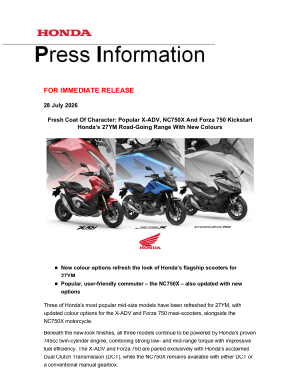
For 27YM, each model receives a refined new colour palette centred on sophisticated neutral tones, enhancing the distinctive bodywork design while reinforcing the premium look and feel shared across the range.
Regular maintenance is essential to keep your Honda Forza 750 reliable, safe, and performing at its best. Following the recommended service intervals helps ensure optimum engine performance, fuel efficiency, riding comfort, and long-term durability.
Before carrying out any scheduled maintenance, always perform the Pre-Ride Inspection described in the Owner’s Manual.
The maintenance items listed in the schedule should be inspected, cleaned, adjusted, lubricated, or replaced as required:
I – Inspect
C – Clean
A – Adjust
L – Lubricate
R – Replace
Some maintenance procedures require specialized tools, technical information, or mechanical expertise. If you are not familiar with a particular procedure, Honda recommends having the work performed by an authorized dealer or qualified technician.
Proper maintenance not only extends the life of your Forza 750 but also contributes to safer and more enjoyable riding throughout the year.
Code
Market / Destination
ED
Europe (European Direct Sales), including countries such as the Netherlands, Belgium, Germany, the United Kingdom, etc.
GS
Gulf States (GCC): United Arab Emirates, Saudi Arabia, Qatar, Kuwait, Bahrain, and Oman.
KO
South Korea.
FO
Taiwan.
CH
This code does not appear in the official Forza 750 manuals. On some other Honda models, CH is used for specific countries or markets, but it does not seem to be a standard destination code for the Forza 750. It may be an internal Honda code found in certain parts databases.
ED, KO, FO TYPES
Items (Distance in km)
1.000
12.000
24.000
36.000
48.000
Annual check
Regular replace
Fuel line
I
I
I
I
I
Throttle operation
I
I
I
I
I
Air cleaner
R
R
Crankcase breather
C
C
C
C
Spark plug
I
R
Valve clearance
I
I
Engine oil
R
R
R
R
R
R
Engine oil filter
R
R
R
Clutch oil filter
R
R
R
Engine idle speed
I
I
I
I
I
Radiator coolant
I
I
I
I
I
3 years
Cooling system
I
I
I
I
I
Evaporative emission control system
I
I
Drive chain
Every 1.000 km (600 mi) I, L
Drive chain slider
I
I
I
I
Brake fluid
I
I
I
I
I
2 years
Brake pads wear
I
I
I
I
I
Brake system
I
I
I
I
I
Brake lock operation
I
I
I
I
Headlight aim
I
I
I
I
I
Sidestand
I
I
I
I
I
Suspension
I
I
I
I
I
Nuts, bolts, fasteners
I
I
I
I
I
Wheels/tires
I
I
I
I
I
Steering head bearings
I
I
I
I
I
Legend: I = Inspect, R = Replace, C = Clean, L = Lubricate
GS, CH Type
Items (Distance in km)
1.000
6.000
12.000
18.000
24.000
30.000
36.000
Annual check
Regular replace
Fuel line
I
I
I
I
Throttle operation
I
I
I
I
Throttle body (For CH type)
C
C
C
Air cleaner
R
R
Air cleaner (For CH type)
R
R
R
Crankcase breather
C
C
C
C
C
C
Spark plug
EVERY 24,000 km (16,000 mi): I
EVERY 48,000 km (32,000 mi): R
Valve clearance
I
Engine oil
R
R
R
R
R
Engine oil filter
R
R
Clutch oil filter
R
R
Engine idle speed
I
I
I
I
Radiator coolant
I
I
I
I
3 years
Cooling system
I
I
I
I
Evaporative emission control system
I
Drive Chain
EVERY 1,000 km (600 mi): I, L
Drive chain slider
I
I
I
Brake fluid
I
I
I
I
I
I
I
2 years
Brake pads wear
I
I
I
I
I
I
I
Brake system
I
I
I
I
I
I
I
Brake lock operation
I
I
I
Headlight aim
I
I
I
I
Sidestand
I
I
I
I
Suspension
I
I
I
I
Nuts, bolts, fasteners
I
I
I
I
Wheels/tires
I
I
I
I
Steering head bearings
I
I
I
I
Legend: I = Inspect, R = Replace, C = Clean, L = Lubricate
Maintenance Notes
The maintenance schedule above is based on the official Honda Owner’s Manual and Workshop Manual for the Honda Forza 750 (NSS750). Depending on riding conditions, such as frequent short trips, dusty environments, or high-speed riding, Honda recommends performing certain maintenance items more frequently. Always refer to the latest Honda documentation for your specific model year.
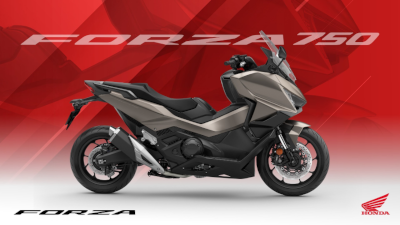
The Honda Forza 750 is Honda’s flagship sport GT scooter featuring a 745 cc parallel-twin engine, Dual Clutch Transmission (DCT), electronic ride modes and cruise control. This page contains one of the most comprehensive Honda Forza 750 technical specification databases available online, including official specifications, workshop data, maintenance information, dimensions, suspension settings, engine specifications and electrical data.